

Table of contents
- Quick Summary
- Why Stock Control Is One of the Clearest Indicators of Business Health
- £17 Million in Excess Liquor Stock: What Venners’ Data Reveals
- Why Excess Stock Is More Than a Stock Problem
- The Real Solution: Building a Stock Control Culture
- What Makes an Effective Stock Control System?
- How to Build a Strong Stock Control Culture
- How Independent Stocktakes Support Better Stock Control
- How Venners Helps Hospitality Businesses Take Control of Stock
- Key Takeaways
Quick Summary
Venners’ analysis of more than 15,000 liquor stocktakes found that pubs and restaurants across the UK are holding an estimated £17 million in excess liquor stock.
While stock is essential to trade, carrying more than is needed can tie up cash, increase the risk of waste and make it harder to identify opportunities to improve profitability.
This article explores what the data reveals about stock control in hospitality, the impact of overstocking on business performance, and how operators can build a stronger stock control culture to optimise stock levels and support long-term profitability.
Why Stock Control Is One of the Clearest Indicators of Business Health
Stock rarely gets the same level of attention as sales, labour costs or rising supplier prices. Yet it can tell operators a great deal about how their business is performing.
Over the years, we’ve worked with thousands of pubs and restaurants, and one thing crops up time and time again: when stock levels start increasing, there’s usually something else going on underneath. It might be over-ordering, products that aren’t selling as expected, or simply a lack of visibility over what’s already available on site.
A business can be busy, sales can look healthy and customers can keep coming through the door, but excess stock may still be building up in the background.
That’s why stock control matters. It’s not just about what’s sitting on a shelf or in a cellar. It’s about understanding whether purchasing, stockholding and demand are properly aligned.
To see how businesses across the sector are managing stock today, Venners analysed more than 15,000 liquor stocktakes from pubs and restaurants across the UK.
£17 Million in Excess Liquor Stock: What Venners’ Data Reveals
Drawing on data from more than 15,000 liquor stocktakes, we found that a significant proportion of pubs and restaurants are holding considerably more stock than recommended.
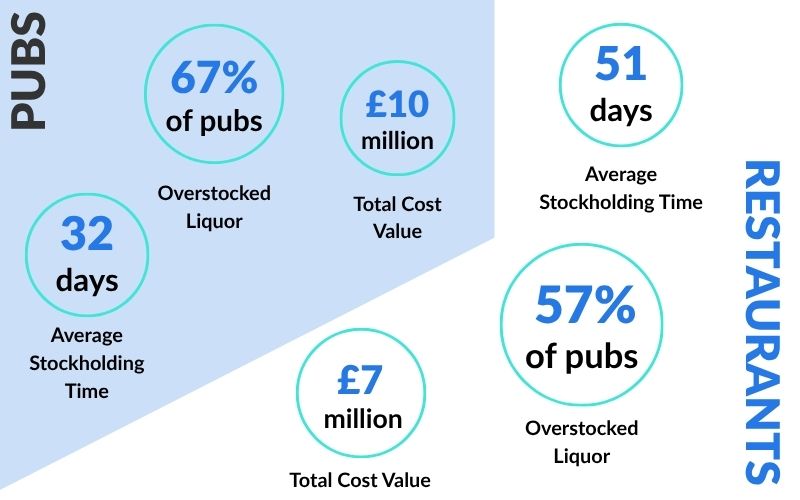
Among the restaurants audited, 57% were found to be overstocked, with excess liquor stock representing a combined cost value of more than £7 million.
The picture was even more pronounced in pubs, where 67% were carrying surplus liquor stock, equating to a total cost value of over £10 million.
The findings also showed that stockholding periods were frequently well above the recommended benchmark of 20 days. On average, restaurants were holding 32 days’ worth of liquor stock, while pubs were carrying 51 days’ worth.
These findings suggest that many operators are holding more stock than they really need.
That doesn’t just take up valuable space. It means money is sitting in bottles, kegs and cases rather than being available elsewhere in the business, whether that’s to support day-to-day cash flow or invest in growth.
The issue is not that operators are carrying stock. Hospitality businesses need stock to trade effectively. The challenge is ensuring stock levels remain proportionate to demand, allowing cash to work harder and reducing the risk of unnecessary losses.
Real-World Example: Improving Visibility Across the Cellar
Our team has seen this countless times in the field.
For example, one site we worked with had no shortage of stock; the challenge was knowing exactly what was there, and how much was actually needed. Products were spread across the cellar and storage areas, making it difficult to maintain consistent stock levels and easy for duplicate ordering to creep in.
Rather than focusing on reducing stock immediately, the first step was to create more structure. Stock was reorganised, products were clearly labelled and agreed par levels were displayed on shelves so teams could see at a glance what should be kept on hand.
Those stock levels were based on the site’s trading patterns and previous stocktake results rather than estimates.
Once the layout was improved, ordering became more straightforward. Managers could see what was in stock without having to search multiple areas, and over time the business was able to reduce the amount of cash tied up in surplus inventory.
The changes had a practical impact on day-to-day management as well. Line checks took less time, stock was easier to locate, and anything unusual was more likely to stand out because everything had a defined place.
It’s a reminder that excess stock isn’t always the result of over-ordering. Sometimes it’s a visibility issue. When operators have a clearer view of what they’re holding, decisions around purchasing and replenishment tend to become much easier.
Why Excess Stock Is More Than a Stock Problem
The £17 million identified through our analysis is about far more than stock alone.
When operators discover they’re carrying more stock than expected, it’s often a sign of something happening elsewhere in the business. It could be products that aren’t selling as anticipated, ordering habits that have gradually changed over time, or simply a lack of visibility over what is already on site.
That’s why excess stock should be viewed as a symptom rather than the problem itself.
In many cases, stock levels increase gradually rather than all at once. A product sells a little more slowly than expected. An order is placed before existing stock has been worked through. Seasonal lines remain on site longer than planned.
Individually, these situations are fairly common. Together, they can result in stock levels creeping higher and higher.
For operators, the financial impact isn’t always obvious. The stock may eventually be sold, but until then, the money spent on it remains tied up in the business.
In some cases, businesses can be carrying thousands of pounds’ worth of liquor that isn’t needed immediately and may not be used for some time.
Without regular reviews, it’s easy for that extra stock to become accepted as normal.

The Real Solution: Building a Stock Control Culture
When operators identify excess stock, the natural reaction is often to focus on reducing orders or clearing slow-moving products.
While those actions may help in the short term, they rarely address the reason excess stock built up in the first place.
In our experience, lasting improvements come from creating a strong stock control culture.
A stock control culture is one where stock is regularly reviewed, questioned and discussed. Managers understand their numbers, teams recognise the value of stock and business decisions are guided by visibility rather than assumptions.
This is important because stock control doesn’t happen once a month during a stocktake. It happens every day through ordering decisions, stock rotation, waste management and purchasing habits.
The businesses that consistently maintain healthy stock levels are often those where stock is treated as an important business asset rather than an operational afterthought.
What Makes an Effective Stock Control System?
There isn’t one stock control method that guarantees success. Businesses differ, trading patterns change and customer demand can be unpredictable.
What we do see, however, are some common habits among operators who consistently maintain tighter control of stock.
They tend to know when stock levels are starting to look higher than they should. They ask questions when products sit around for too long. They review what they’re ordering and whether it still reflects what’s actually selling.
They are also less likely to accept stock levels simply because “that’s how they’ve always been”. Stock is regularly challenged. Slow-moving products are identified, ageing lines are cleared and surplus stock is addressed before it becomes a bigger issue.
Understanding how current stock levels compare to the recommended 20-day benchmark can often provide a useful starting point.
Independent stocktakes play an important role too. They give operators a chance to look at stock with fresh eyes.
It’s often during a stocktake that questions start to emerge:
Why has a particular category grown? Why are certain lines still sitting in the cellar? Why are stock levels higher than they were six months ago?
Stock control is rarely won or lost in a single month. It develops over time through hundreds of small decisions.
The businesses that tend to stay in control are usually the ones that review stock regularly, challenge unusual results, and remain curious when something doesn’t look quite right.
This is one of the reasons optimisation is so important.
The aim isn’t to hold as little stock as possible. It’s to hold the right stock, in the right quantities, for the business you’re operating today.
How to Build a Strong Stock Control Culture
Building a stock control culture doesn’t require complex processes. More often, it comes down to a handful of habits that are applied consistently across the business.
Make Stock Accountability Part of Every Manager’s Role
In businesses with strong stock control, managers don’t wait for someone else to tell them there’s a problem.
They understand their stock results, know when levels have changed and take an interest in what’s driving those changes. If a category suddenly grows, they want to know why. If stockholding increases, they don’t just accept it as business as usual.
In many pubs, the General Manager sets the standard. When they’re interested in stock, ask questions about results and challenge unusual numbers, the rest of the team tends to follow.
That level of ownership makes a difference.
Help Teams Understand the Value of Stock
People often think about stock in terms of products rather than value.
A shelf full of spirits looks like stock. A cellar full of kegs looks like stock. What’s easier to miss is the amount of money tied up in them.
A product that’s slow to sell can be easy to ignore when it’s sitting on a shelf. It’s a different story when it’s viewed as cash that’s been tied up for months. That shift in perspective can make a real difference to the way stock is managed day to day.
Review Results Regularly and Act on Them
The best stock reports in the world are useless if they are filed away and forgotten.
The operators who stay closest to their stock position tend to review results regularly and follow up on anything unexpected. Sometimes there will be a straightforward explanation. Other times, those conversations uncover habits that have gradually developed over months or even years.
Building a stock control culture isn’t about creating extra work. It’s about creating an environment where stock gets the same attention as other key areas of the business. When that happens, issues are more likely to be identified early and improvements become much easier to sustain.

How Independent Stocktakes Support Better Stock Control
Independent stocktakes remain one of the most effective ways to maintain visibility over stock performance.
They provide an opportunity to step back from day-to-day operations and look at stock with fresh eyes.
It’s often during a stocktake that important questions begin to emerge:
- Why has a particular category grown?
- Why are certain lines still sitting in the cellar?
- Why are stock levels higher than they were six months ago?
The answers can help operators identify areas where cash is tied up unnecessarily, challenge long-standing assumptions and improve overall stock performance.
For many businesses, independent stocktakes provide the insight needed to strengthen controls, improve accountability and support better decision-making.
How Venners Helps Hospitality Businesses Take Control of Stock
An accurate stocktake is only useful if something is done with the information afterwards.
That’s where Venners adds value. We work with operators to help them understand what’s driving their results, where stockholding may be higher than expected and which areas of the business would benefit from closer attention.
Sometimes that means identifying slow-moving stock that has gradually built up over time. In other cases, it might involve challenging ordering habits, investigating variances, or helping managers gain a clearer understanding of their stock performance.
By identifying excess and slow-moving stock at individual sites, we’re able to provide practical stock transfer recommendations that help stock move to where it’s most likely to be sold.
Products with low demand at one location can often be matched to stronger consumption patterns elsewhere in the group, helping release cash, reduce waste and improve stock turn without affecting availability.
A stocktake can also help operators understand whether they’re holding the right amount of stock in the first place. Venners reports provide an indication of how long stock is likely to last at current trading levels, giving managers a clearer view of where stockholding may be higher than it needs to be.
Whatever the starting point, better decisions begin with having a clear picture of what’s actually happening in the business. Stocktake data provides that visibility, turning assumptions into facts and helping operators make more informed decisions about the stock they’re carrying and the cash tied up within it.
Key Takeaways
- Venners’ analysis of more than 15,000 liquor stocktakes found an estimated £17 million in excess liquor stock tied up across UK pubs and restaurants.
- 67% of pubs and 57% of restaurants audited were holding more liquor stock than recommended.
- Average liquor stockholding levels were 51 days in pubs and 32 days in restaurants, both above the recommended 20-day benchmark.
- Excess stock can tie up cash, make slow-moving products harder to spot and increase the risk of avoidable losses.
- Stock levels often provide an early indication of wider issues, including over-ordering, poor visibility and inefficient stock management.
- Operators should aim to optimise stock levels, not simply reduce them.
- Effective stock control relies on regular reviews, independent stocktakes and a willingness to question stock that is no longer earning its place.
- A strong stock control system is built on visibility, accountability and informed decision-making.
- Building a stock control culture helps managers and teams understand the value of stock and the impact it can have on profitability.
- Businesses that treat stock with the same level of attention as cash are often better placed to protect margins, improve cash flow and maintain control of their operation.
Want more advice?
Book your free initial consultation with us.